
Changing consumer preferences is hurting this alcohol distributor

Alcohol was long seen as a reliable investment over long periods of time because of its status as a staple. Hence, demand typically remains inelastic.
However, demand for alcoholic beverages like beer has declined due to a shift in consumer behavior. A significant number of drinkers are starting to abandon alcohol for healthier drinks.
As a result, Constellation Brands (STZ), known for being the importer of Modelo and Corona has been negatively affected.
During its most recent quarter, the company saw its revenues decline due to slowing demand. Despite this, investors view this company positively—an assessment that may be too optimistic given the headwinds Constellation Brands is currently facing.
Investor Essentials Daily:
Friday News-based Update
Powered by Valens Research
For a long time, alcohol has been seen as a reliable investment because of its status as a consumer staple.
Historically, demand for alcoholic beverages tends to stay inelastic regardless of a consumer’s financial situation or current economic condition.
And while the alcohol industry has seen relatively stable demand over the past several decades, this trend seems to be shifting today. Customers have become increasingly health-oriented. And as a result, alcohol in general, and beer specifically, has seen lower demand from consumers.
The number of American adults who drink alcohol has fallen to 54%, down from the 67% in 2022. Moreover, beer, long considered as the preferred beverage for 47% of U.S. drinkers, is now just favored by 34% of consumers.
This shift in consumer behavior is hurting companies that specialize in alcoholic beverages.
Among these companies is Constellation Brands (STZ).
The alcoholic beverage firm is primarily known for being the distributor of popular beer brands Modelo and Corona. It also owns a variety of wine brands including Robert Mondavi Winery, Lingua Franca, and spirits brands like Casa Noble Tequila and High West Whiskey.
Modelo was the top-selling beer in the U.S. since 2023, until it was overtaken by Michelob Ultra in 2025. Even though Modelo lost the top spot, it remained the top-selling beer by dollars spent. Meanwhile, Corona consistently ranks as one of the most popular beer brands in the U.S.
Unfortunately, Constellation Brands has been negatively impacted not only by a behavioral shift but also weakening consumer sentiment. And this was apparent in its most recent quarter.
Earlier this week, Constellation Brands announced results for the third quarter of its 2026 fiscal year. The company reported revenues of $2.22 billion, a 9.8% decline year-over-year.
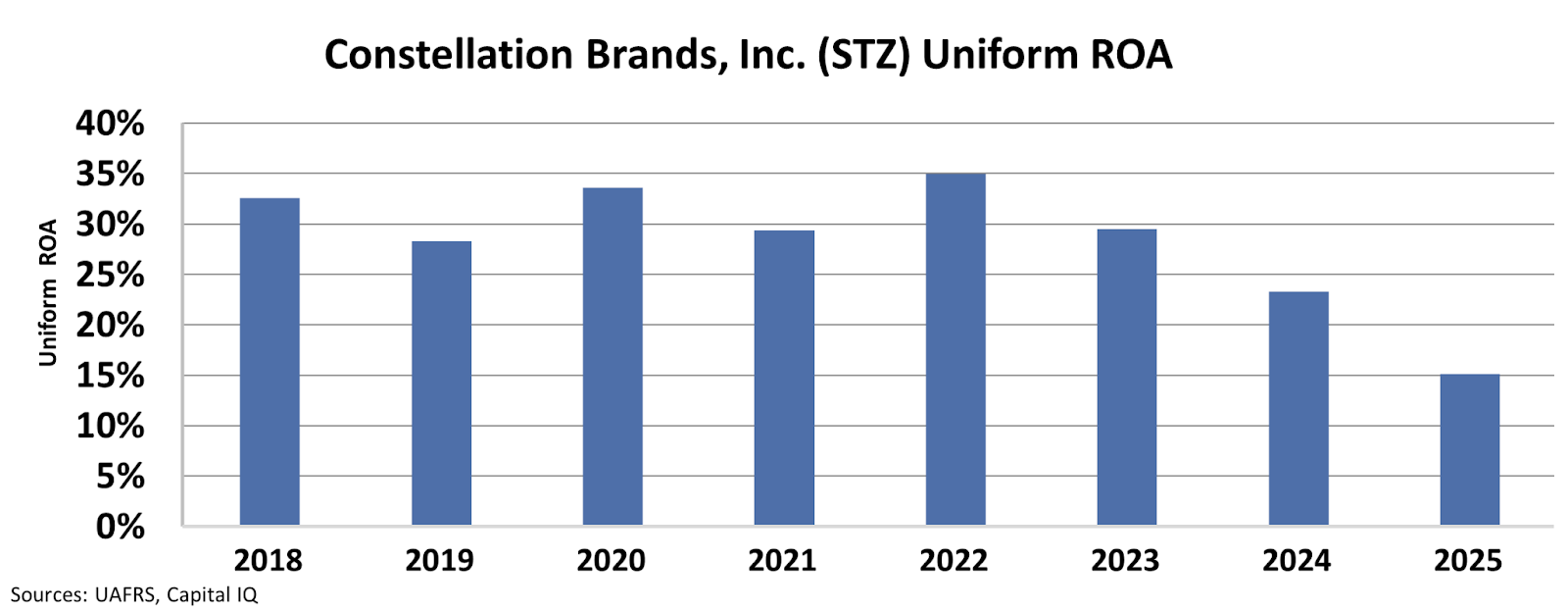
This decline isn’t just a quarterly one-off. Uniform Accounting reveals that the company’s profitability has been on the decline since 2022.
Constellation Brands’ Uniform return on assets (“ROA”) dipped from 35% in 2023 to 15% last year.
Meanwhile, investors are expecting returns for the company to level out in the next few years. And we can see through Valens’ Embedded Expectations Analysis (“EEA”) framework.
The EEA starts by looking at a company’s current stock price. From there, we can calculate what the market expects from the company’s future cash flows. We then compare that with our own cash-flow projections.
In short, it tells us how well a company has to perform in the future to be worth what the market is paying for it today.
Investors expect the company’s returns to level out at 14% by 2030, representing the company’s lowest level in profitability for over a decade.
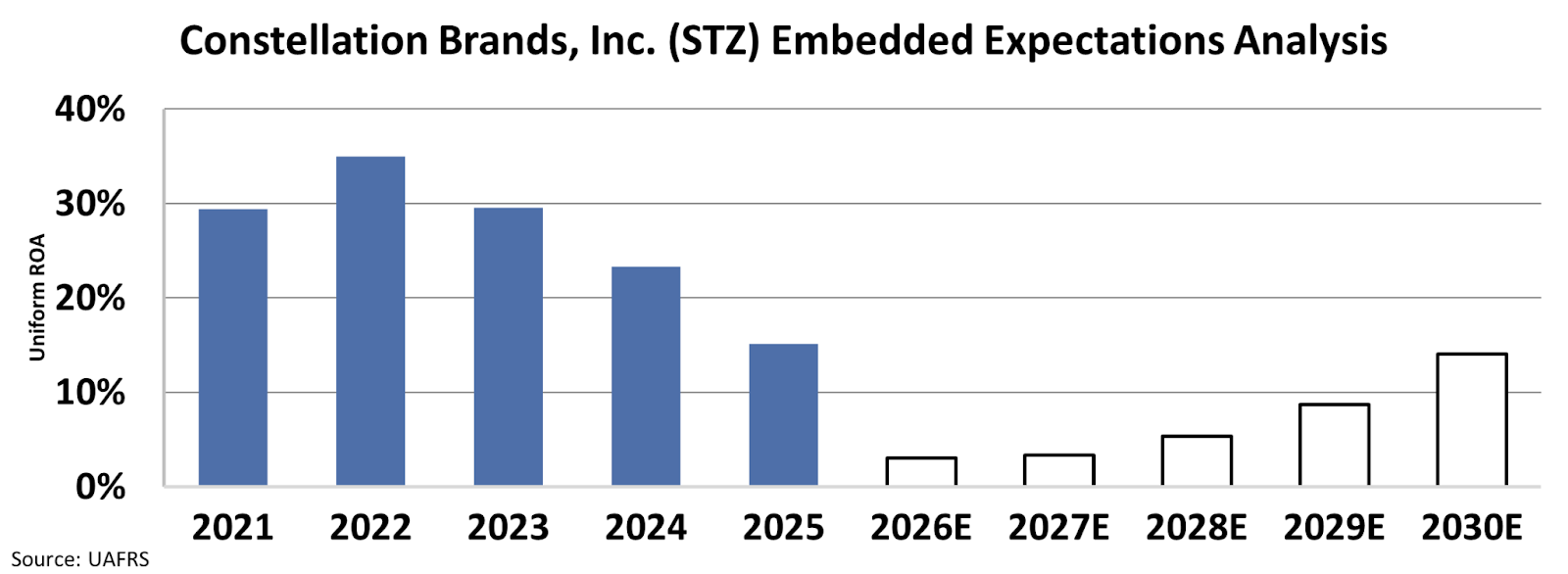
Given the market’s shifting stance towards alcohol, and Constellation’s own profitability decline in recent years, the market’s forecast may still be overly optimistic.
Investors should take a cautious approach to this company and other players in the alcohol space.
Best regards,
Joel Litman & Rob Spivey
Chief Investment Officer &
Director of Research
at Valens Research