
Internal combustion engines are here to stay and this company is positioned to benefit

Over the past few years, electric vehicles have gained ground in the consumer market, with EV technology improving year by year.
As a result, automotive industry heavyweights like Ford (F) invested billions to position themselves to benefit from the adoption of EVs.
However, instead of going full steam ahead, the transition to EVs is starting to ground to a halt as it enters an uncertain phase due to a combination of rollback of EV mandates, expensive prices, and consequently, shrinking consumer demand.
While there’s no doubt that EVs will remain a fixture in the automotive market for years to come, reliance on internal combustion engines will remain.
As a result, companies that provide the critical components in the upkeep of gas-powered engines like Atmus Filtration Technologies (ATMU) are positioned to take advantage of this market trend.
Investor Essentials Daily:
Thursday News-based Update
Powered by Valens Research
The transition to electric vehicles (“EV”) was billed as one of the most significant developments in the automotive industry.
Over the last few years, EV technology has improved and automotive giants like Ford (F) spent billions of dollars to position themselves as major players in the transition from vehicles powered by internal combustion engines to EVs and hybrids.
This trend was further boosted by the Biden administration which enacted various clean-air and fuel economy mandates alongside EV-related subsidies.
However, it seems that instead of going full steam ahead, the EV transition is grounding to a halt as the EV industry enters a more volatile and uncertain phase due in part to the Trump administration’s decision to do away with EV adoption mandates, expensive prices, and shrinking demand from customers.
Earlier this week, Ford announced that it was taking a $19.5 billion hit primarily tied to its EV segment and subsequently revealed that it would redeploy its capital to the manufacture and development of gas-powered vehicles, hybrids, and extended-range EVs that are equipped with traditional combustion engines.
This pivot is unsurprising given that the company has lost $13 billion on its EV segment since 2023.
And while EV technology has vastly improved, adoption has been slowed by high prices and customer concerns over battery range and access to charging stations.
Despite this pullback, there’s still a chance that EVs and hybrids may one day surpass their gas-powered counterparts. But until then, combustion-powered vehicles may still have a longer runway ahead of them.
With gas-powered engines here to stay for a little while longer, companies like Atmus Filtration Technologies (ATMU) stand to benefit from the continued reliance on these engines.
Atmus is a company that specializes in the design and manufacturing of air and fuel filters, coolants, and fuel cells for trucks and other large vehicles.
Around two-thirds of all freight weight is delivered by trucks in the U.S., making these large vehicles the primary logistics solution of choice as these can carry various goods and can take advantage of America’s vast road networks.
Since these trucks undergo lots of wear and tear and need to be maintained regularly, Atmus’ offerings are well-positioned to fill this need.
For example, over the course of a truck’s operational lifespan, its oil filter will be replaced between 30 and 40 times while its fuel filters will be swapped out from around 50 to 75 times. Air filters on the other hand, need roughly 30 to 60 replacements.
Around 86% of Atmus’ revenue comes from aftermarket sales of those critical vehicle components. And right now, the company is the largest pure play firm in filtration for large industrial vehicles.
Atmus is a critical player in the space it is operating in. However, that hasn’t stopped investors from having concerns about its profitability due to the emergence of EV technology.
However, while EVs may have gained popularity in the consumer market, it’s still a long ways off from gaining ground in long-haul trucks. At present, electric-powered trucks lack the operating range combustion-powered vehicles have and there aren’t enough charging stations to make the option viable.
Simply said, Atmus is a market leader. But some investors have yet to treat it as one.
Based on as-reported numbers, the company, since 2021, has generated an average return on assets (“ROA”) of 14%, slightly above the 12% corporate average. However, while as-reported metrics show Atmus as an above-average firm, it still hides just how profitable it is.
When viewed through the lens of Uniform Accounting, the company, in the same period, has generated an above-average Uniform ROA of 20%.
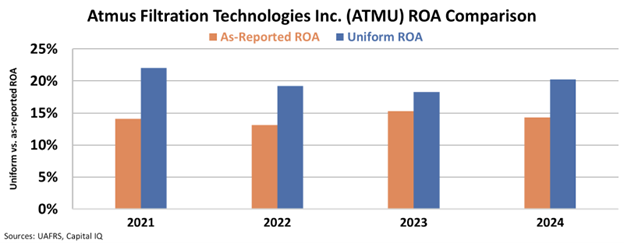
With combustion-powered vehicles and trucks here to stay, Atmus is well-positioned to capitalize on this tailwind and maintain or grow its returns.
This being the case, the company presents an interesting opportunity for investors who realize just how profitable Atmus is.
Best regards,
Joel Litman & Rob Spivey
Chief Investment Officer &
Director of Research
at Valens Research