
Tech giants are willing to pay hefty premiums for energy, and this company is poised to benefit

Microsoft and Meta have both agreed to pay hefty premiums for nuclear power via virtual power purchase agreements, signaling a new trend among tech giants who want immediate access to secure, clean, and reliable energy.
These deals are poised to boost Constellation Energy’s (CEG) profitability and pricing power without the need for construction of new infrastructure.
These long-term, fixed priced contracts indicate that investors are beginning to recognize the value of these arrangements, leading market expectations to get higher and higher.
Investor Essentials Daily:
Wednesday News-based Update
Powered by Valens Research
When Microsoft (MSFT) struck a deal to restart part of the Three Mile Island nuclear plant, it made a brief splash in the headlines. Then the story all but disappeared.
Most people figured it was a one-off. A splashy sustainability play. Maybe a goodwill gesture to restart a shuttered facility.
But they missed something big: Microsoft reportedly agreed to pay between $110 and $115 per megawatt-hour (“MWh”) for that power. That’s more than double the going rate.
It seemed like a fluke back then until Meta Platforms (META) joined the game.
Earlier last month, Meta signed a 20-year agreement to buy nuclear power from Constellation Energy’s (CEG) Clinton Clean Energy Center in Illinois.
Analysts believe it’s paying a premium too, somewhere between $85 and $90 per MWh.
And just like that, overpaying for energy became a trend.
Investors can no longer afford to ignore the uptick in energy prices and what it means for energy vendors like Constellation Energy (CEG).
Companies like Constellation don’t need to wait years (or spend billions of dollars) for their projects to come online. They already have facilities set up.
That’s why tech companies are racing to make new energy deals at any cost. As soon as the ink dries, they can start accessing power.
And it’s great for Constellation, too. Any premium it charges goes straight to the bottom line.
The Clinton plant is a perfect example. It was previously supported by state credits to stay open. Meta’s deal replaces those subsidies.
And Constellation is planning to expand capacity, adding 30 megawatts of additional generation to its existing 1.1 gigawatts.
It’s important to understand that these deals don’t transfer energy from one party to another. They’re happening in the context of virtual power purchase agreements (“PPAs”).
With a virtual PPA, a company pays a fixed price for clean power it never physically receives. In return, it gets the rights to the project’s carbon-free attributes, like renewable or nuclear energy credits.
Said another way, it helps tech companies meet environmental goals while buying power from the general grid.
Recent deals show just how badly tech firms want clean, stable energy. They’re willing to double the going rate because they need the power… and they need it now.
Constellation is among the biggest providers of a consistent clean energy supply. That’s why it has been inking the biggest deals so far.
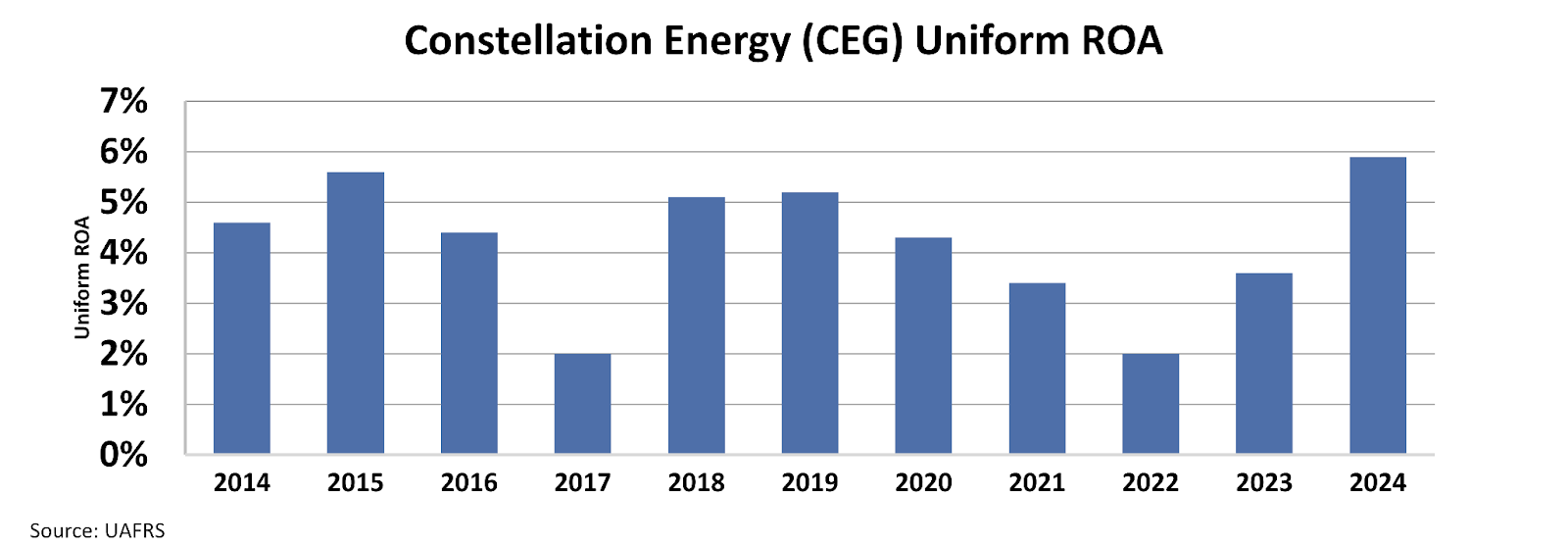
As a result, the company’s Uniform return on assets “ROA” reached 6% last year—its highest level in the past decade.
The market is just starting to catch on to these tailwinds.
We can see what the market thinks through our Embedded Expectations Analysis (“EEA”) framework.
The EEA starts by looking at a company’s current stock price. From there, we can calculate what the market expects from the company’s future cash flows. We then compare that with our own cash-flow projections.
In short, it tells us how well a company has to perform in the future to be worth what the market is paying for it today.
The market expects last year’s number to nearly double, hitting 11% by 2029…
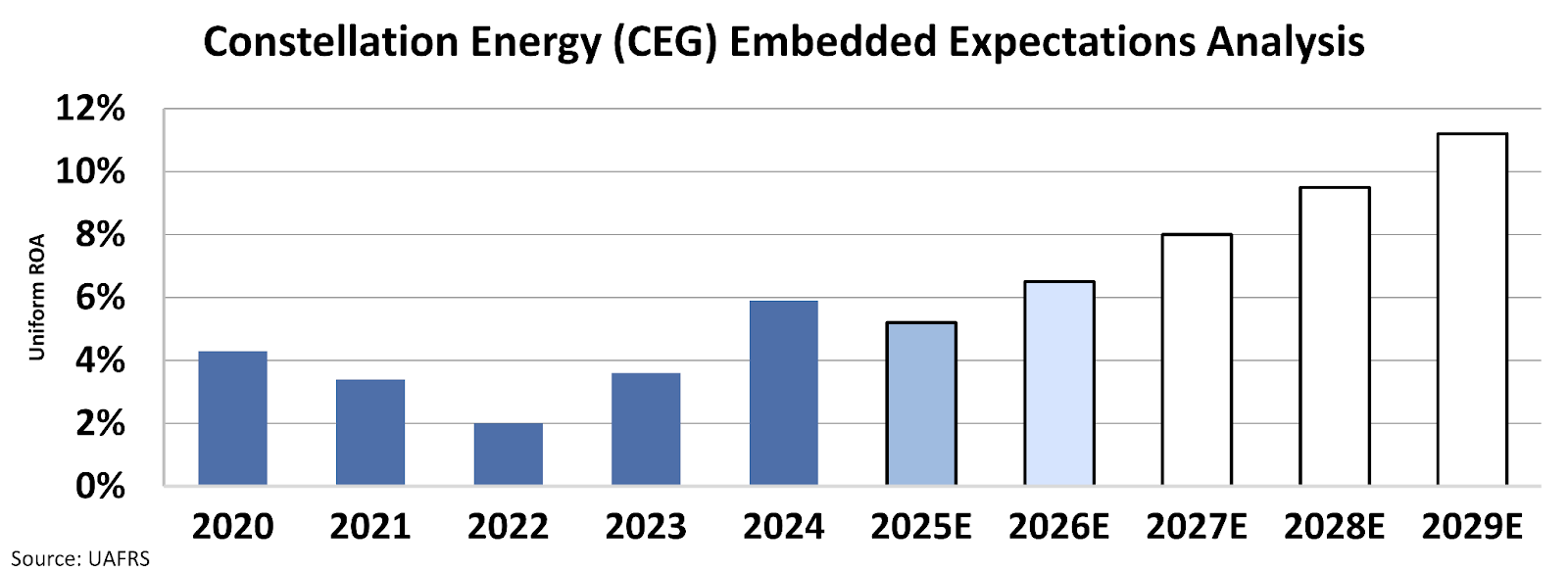
The market is just starting to recognize how transformative these premium deals can be. In fact, because its energy projects take a lot of up-front investment, doubling the price paid could lead to more than twice the return.
Investors might worry valuations were getting ahead of fundamentals. But looking at Microsoft and Meta, it’s clear this shift is already here. The demand is locked in with 20-year contracts.
The story has changed. Constellation finally has pricing power… and the market is starting to take notice.
Best regards,
Joel Litman & Rob Spivey
Chief Investment Officer &
Director of Research
at Valens Research