
The brewer behind craft beer brand Sam Adams is betting on its founder and former CEO to turn its fortunes around

The alcohol industry is currently experiencing a downturn as consumption has been dented by changing consumer tastes and preferences.
As consumers have become increasingly health-focused, many of them have cut their consumption of alcohol, with as many as 56% having done so. Aside from this, weight-loss drugs and other non-alcoholic beverages have curbed demand for liquor.
These recent shifts in consumer behavior are hurting companies like Boston Beer Company (SAM), the maker of popular craft beer Sam Adams.
Years of underperformance have led the company to reinstate its founder and former CEO Jim Koch.
The company is betting that Koch’s experience and deep knowledge of the alcohol industry can help it recapture some of the glory it has lost and help it navigate an industry that’s going through massive changes.
Investor Essentials Daily:
Friday News-based Update
Powered by Valens Research
Alcohol has long been seen as a reliable investment over long periods of time because it is widely considered a consumer staple.
Consumer demand for alcoholic beverages often stays inelastic, even if financial situations change. That said, evolving consumer behaviors and tastes can lead to shifts in demand.
And while the alcohol industry has seen relatively stable demand over the past few decades, this appears to be changing today. As consumers have become increasingly health-oriented, alcohol, and beer specifically, have faced growing criticism from consumers and health professionals.
In fact, 56% of adults have reduced alcohol consumption due health reasons. This comes as recent studies have shown the health risks posed by beer and its links to cancer. Furthermore, beer, which was once considered as the preferred alcoholic beverage for 47% of American drinkers is now favored by just 34% of consumers.
Aside from declining consumption, weight-loss drugs and other types of beverages have dented overall demand for alcohol.
These trends in consumer behavior are hurting companies like Molson Coors (TAP), whose product portfolio heavily revolves around beer. And this beer maker isn’t the only one being hit by these changes.
Boston Beer Company (SAM), the maker of popular craft beer Sam Adams, is reeling from the downturn as well.
As a result, the company has turned to a familiar face to help the business weather the current storm.
A few weeks ago, former CEO Michael Spillane formally turned over the reins of the company to Jim Koch.
Koch isn’t just a long-time company stalwart—he was the one who founded Boston Beer in 1984 and was responsible for taking it public in 1995.
Koch served as CEO until he relinquished his post in 2001. Despite stepping down, he continued to have an influence at the company he founded, staying on as company chairman and making frequent appearances at industry events and participating during earnings calls.
For years, Boston Beer succeeded even without its founder at the helm. Revenue grew 12% per year from 2001 to 2020, while operating profits rose from just $12 million to $249 million.
However, the company struggled following the pandemic as inventories mounted and consumers began swapping beer for healthier alternatives.
Most recently, during the second quarter this year, sales volume dropped by 5% compared to the same period last year. Moreover, product categories such as teas and seltzer have taken a nosedive as well, with sales in this segment falling by 7% during the same period this year.
As a result, the company’s profitability has taken a turn for the worse.
From 2014 to 2020, Boston Beer’s Uniform return on assets (“ROA”) averaged 18%. However, since then, Uniform ROA has fallen to around 7% levels, well below its historic average.
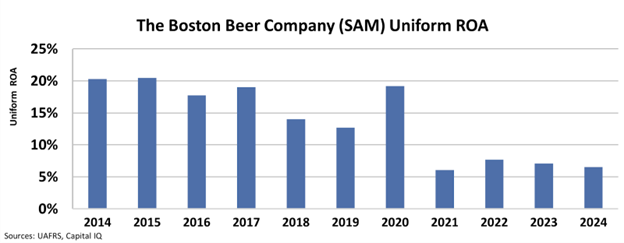
Considering these results, it’s little surprise that Boston Beer is looking to change its leadership.
Koch’s reinstatement stems from the belief that his experience and deep knowledge of the industry can help the company navigate the hard times it is currently in and ultimately, regain its ability to generate returns in line with its historical performance.
This is also an opportunity to groom Boston Company’s next leader, as Koch has stated that he will only stay on as CEO on an interim basis.
It will take some time to see whether this leadership change will pay off or not. For now, investors should remain cautious, especially as the alcohol industry continues to reckon with changing consumer tastes and preferences.
Best regards,
Joel Litman & Rob Spivey
Chief Investment Officer &
Director of Research
at Valens Research