
This airline is taking a page out of its competitors’ playbooks

Southwest Airlines (LUV) set itself apart for years by positioning itself as a low-cost airline with a scale that’s on par with rivals like Delta Air Lines, United Airlines, and others.
Policies such as open-seating and free checked baggage endeared the airline to passengers, securing a loyal customer base.
This strategy worked for decades, but the COVID-19 pandemic upended Southwest’s business. And even though the company has recovered from its pandemic woes, it’s the least profitable of its peers.
As a result, the airline is taking a page out of its rivals’ playbook.
Investor Essentials Daily:
Wednesday News-based Update
Powered by Valens Research
Southwest Airlines (LUV) set itself apart from its peers for years by positioning itself as a low-cost airline despite having a scale that’s on par with giants like Delta Air Lines (DAL), United Airlines (UAL), and American Airlines (AAL).
Southwest secured customer loyalty by not charging them for checked baggage and enforcing an open-seating policy.
By enforcing such policies, the airline offered a unique and cheaper option to travelers while providing better service than true discount airlines like Spirit Airlines and Frontier Airlines.
This strategy worked for years and enabled Southwest to scale while simultaneously keeping costs lower than its rivals.
Unfortunately, the COVID-19 pandemic unraveled Southwest’s winning formula, as the health crisis ground travel activity to a halt.
Even after the pandemic ended, Southwest continued to show cracks. In one instance, a late-2022 scheduling problem led to roughly 17,000 cancelled flights, resulting in lasting brand damage and a regulatory penalty of $140 million—on top of $600 million in passenger refunds.
Meanwhile, the company pressed on with its aggressive expansion strategy and its checked baggage and open-seating policies.
And while these policies endeared the airline to its target customers, these held it back from generating revenues that rival its competitors.
From 2022 to 2025, Southwest delivered revenues above $23 billion. On the other hand, American Airlines and Delta Air Lines generated revenues well above the $50 billion mark in the same period.
With Southwest lagging behind its rivals, investor sentiment turned against the company. Activist investor Elliott Investment Management even took a nearly $2 billion stake in 2024, demanding leadership changes at the CEO and board levels and a shift in its business model.
Even though a leadership shakeup hasn’t occurred since then, Southwest has slowly taken steps to shake up its business model. Last year, the company started charging for checked baggage, marking the end for one of its trademark perks.
And now, the airline is introducing another change: The end of its open-seating policy.
Initially announced in 2024, Southwest started offering assigned seating to passengers on January 27, 2026. This change allows the airline to charge more for amenities like extra legroom and introduce price-tiered seats.
The shift to assigned seating puts Southwest at par with Delta and United which both operate on a model that maximizes revenue by offering various seat options to travelers.
While this shakeup can potentially scare loyal customers away, management says bookings remained strong during the first few weeks of 2026.
Uniform Accounting reveals why Southwest is taking this radical step.
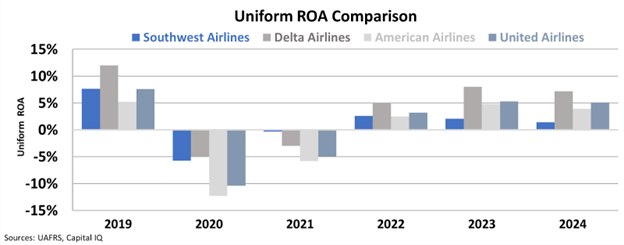
Southwest’s Uniform return on assets (“ROA”) declined from 7% in 2019 to -5.7% in 2020. While returns turned positive in 2022 at 2.6%, the company’s returns dropped to 1.4% by 2024.
Even though every airline in the chart below delivered negative returns in 2020 and 2021 and showed recovery starting in 2022, Southwest has been the least profitable of its peers post-pandemic.
Since 2022, Delta delivered an average ROA of 7%, meanwhile, American Airlines and United generated returns of 4% and 5%, respectively. In contrast, Southwest delivered a lackluster average of 2%.
And it’s not surprising why—the airline’s operating model prevented it from delivering returns similar to what its competitors enjoyed.
With this in mind, it’s no surprise Southwest is taking steps to abandon its niche for a more profitable model. While its core strategy has helped build a loyal customer base, it has held the company back from delivering revenues on par with its peers. The company is now hoping to improve profitability by adopting its competitors’ playbook.
Best regards,
Joel Litman & Rob Spivey
Chief Investment Officer &
Director of Research
at Valens Research