
This candy empire continues to deliver despite cost pressures and inflation

Years of price inflation have finally caught up to consumers, forcing them to tighten spending and trade down to cheaper alternatives.
As a result, food companies have been negatively affected, delivering lower sales while also dealing with higher input costs.
Amid this environment, the Hershey Company (HSY) has continued to generate strong returns by optimizing and leveraging a decades-old playbook.
Investor Essentials Daily:
Tuesday News-based Update
Powered by Valens Research
Years of price inflation, high interest rates, a cooling job market, and rising delinquencies have forced consumers to tighten their spending and trade down to cheaper alternatives to get by.
Food companies have been negatively impacted as a result. And on top of this, these firms have had to contend with higher input costs as well.
Despite this volatile environment, the Hershey Company (HSY) continues to deliver strong returns.
Hershey is a 132-year-old confectionery company headquartered in Hershey, Pennsylvania and owns notable snack brands like the eponymous Hershey’s, Reese’s, and others.
For decades, the company has built itself up as a brand that sold low-cost chocolate products, selling it for only 5 cents per piece when the first Hershey bar hit shelves in 1900.
However, as chocolate became more popular and competition intensified, the company was forced to contend with rising cocoa prices—the single most important ingredient in a chocolate bar.
Hershey initially resisted raising prices, opting to shrink the size of its chocolate bars instead. But by 1969, it was finally forced to raise prices from 5 cents to 10 cents per piece, all while reverting its chocolate bars to their original size due to rising cocoa costs.
Hershey’s strategy of price hikes and reduced product sizes throughout the 1960s and 1970s set the framework for its long-term pricing model.
And as it turns out, the company is currently facing the same problem it encountered decades ago.
Cocoa prices fluctuated between $2,100 and $3,500 per tonne from 2010 to 2016 before stabilizing below $2,750 until mid-2023.
Adverse weather and crop diseases in Ghana subsequently triggered a supply shock that drove prices to a peak of $10,000 per tonne by April 2024.
As one of the world’s largest cocoa buyers, Hershey was impacted negatively, causing its stock to fall from $270 in early 2023 to under $200 by May 2025. Shares have since recovered to approximately $236 as of March 2026.
Investors were worried that high cocoa prices would hurt the company long-term, hence the selloffs.
However, Hershey already has experience dealing with cocoa price hikes, enabling it to navigate this challenge effectively.
During previous input price spikes in the 20th century, Hershey frequently turned to shrinkflation to reduce the size of its products. This, along with raising prices, helped offset the impacts of mounting cocoa prices.
The company is implementing this same strategy today. In recent years Hershey has introduced “thin” versions of popular products like Reese’s and Kit Kat.
And last year the company raised prices by double digits to help offset commodity prices. In addition, the company has streamlined its supply chain to cut down on manufacturing and logistics expenses.
Moreover, Hershey utilizes futures contracts to mitigate the effect of rising costs. As a result, the company has proven resilient despite recent cocoa fluctuations.
Since 2020, Hershey’s Uniform return on assets (“ROA”) has consistently topped 20%. In 2024, Hershey delivered a Uniform ROA of 35%.
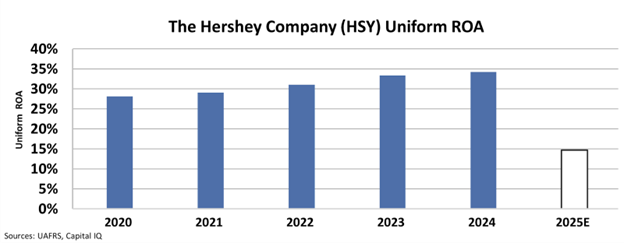
While the company’s returns are expected to take a hit for fiscal 2025 as a result of elevated commodity prices, the company’s efforts to offset rising costs and track record of doing so going back 100 years gives confidence that this company will be able to return to its historic profitability levels quickly.
Recent commodity price volatility could present an opportunity for investors to profit from a stalwart of the candy industry.
Best regards,
Joel Litman & Rob Spivey
Chief Investment Officer &
Director of Research
at Valens Research