
This global diagnostics company is positioned to generate stronger returns as demand for early cancer detection grows

Cancer is one of the most formidable health challenges American society is facing today. In the U.S. alone, the oncology market is valued at around $250 billion.
While some cancers are notably aggressive and pose serious risks, the survivability of this disease is greatly improved by early diagnostics. In fact, the five-year survivability rate for many types of common cancers exceeds 90% if detected at an early stage.
Diagnostics is a key component of cancer treatment, which is why the market is worth $110 billion today, and expected to reach $155 billion by 2030.
Survivability has increased due to the discovery of new treatments and improvements in early detection. A key driver of these advancements in early detection has been the development of molecular diagnostics tools.
Veracyte (VCYT) makes it easier to test for various types of cancers as its proprietary screening methods are noninvasive which poses lesser risks for patients.
However, despite the company’s leadership position and improving profitability in a growing market, investors are doubting this business.
If the company can succeed in improving its current testing methods, it can continue to sustain its returns, presenting a compelling investing opportunity.
Investor Essentials Daily:
Tuesday News-based Update
Powered by Valens Research
Cancer is one of the most formidable health challenges American society is facing today. In the U.S. alone, the oncology market is valued at around $250 billion, encompassing the various diagnostic, pharmaceutical, and supportive care services aimed at treating different types of cancers.
While some cancers are notably aggressive and pose serious risks, the survivability of this disease is greatly improved by early diagnostics. In fact, the five-year survivability rate for many types of common cancers exceeds 90% if detected at an early stage.
Diagnostics is a key component of cancer treatment, which is why the market is worth $110 billion today, and expected to reach $155 billion by 2030.
However, not all screening methods are the same. Common screening methods like biopsies, where tissue is removed through surgery or with a needle, or bronchoscopies, which involves a tube being inserted into a person’s airway, can be invasive and pose risks for patients.
Veracyte (VCYT) makes it easier for people to test for various types of cancers. Its proprietary tests are designed to provide medical practitioners with insights to diagnose and treat cancer patients.
Specifically, the company utilizes gene sequencing classifiers and DNA analysis for diagnosis. Its methods range from a nasal swab that replaces the need for bronchoscopies for lung cancer, to studying small blood samples with AI in place of biopsies.
Today, Veracyte provides tests for identifying thyroid, prostate, lung, breast, bladder, and kidney cancers through a portfolio of six different tests. As a leader in oncology testing, Veracyte diagnoses hundreds of patients each year.
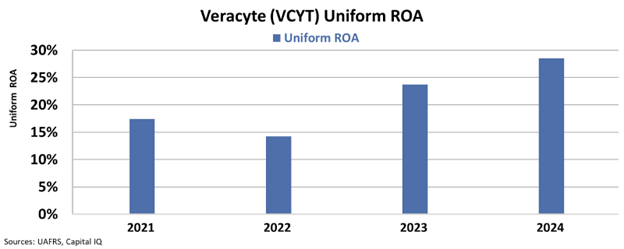
And as the oncology market has grown, the company’s Uniform return on assets (“ROA”) has expanded from 17% in 2021 to 29% today.
Veracyte’s Decipher test, which tests for prostate cancer, has seen an increase in volume for 28 consecutive quarters. Meanwhile, utilization for Afirma, which is used in thyroid cancer screening, has grown steadily for the past few quarters.
Increased adoption of these tests helped the firm grow its testing revenue from $107 million in the second quarter of 2024 to $122 million in the second quarter of 2025, representing a 14% YoY growth.
Despite the company’s leadership position and improving profitability in a growing market, investors are doubting this business. Veracyte currently trades at an 18.1x Uniform P/E, below corporate averages.
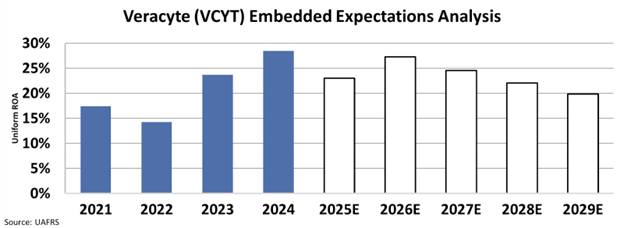
At this valuation, the market is expecting Veracyte’s profitability to decline from recent highs.
We can see what the market thinks through our Embedded Expectations Analysis (“EEA”) framework.
The EEA starts by looking at a company’s current stock price. From there, we can calculate what the market expects from the company’s future cash flows. We then compare that with our own cash-flow projections.
In short, it tells us how well a company has to perform in the future to be worth what the market is paying for it today.
At the current stock price, the market expects the company’s Uniform ROA to decline to around 20% by 2029.
In addition to its already leading platform of diagnostic solutions, Veracyte is actively investing in ways to improve its current gene-analysis testing solutions as well as further integrate AI into its business to help develop earlier detection methods for bladder and other types of cancers.
If Veracyte can succeed in improving its current testing methods, its ROA could continue its recent ascent, in contrast to the market’s current pessimistic outlook, posing a potentially compelling investing opportunity.
Best regards,
Joel Litman & Rob Spivey
Chief Investment Officer &
Director of Research
at Valens Research