
This mission-critical contractor is poised to sustain its growth and returns

With tensions and conflicts rising across the globe, the need for increased defense spending has intensified to ensure American military readiness.
While most investors typically think of major manufacturers of advanced weapon systems and equipment when they encounter the defense sector, there’s a subsection devoted to logistics and mission-critical support.
Contractor V2X (VVX) specializes in this department, providing logistical support for the various branches of the U.S. military.
For years, the company has delivered returns well above 20% through a combination of fixed cost and cost-plus arrangements.
Yet despite this, investors are forecasting a steep decline in returns for V2X in the next few years.
Investor Essentials Daily:
Tuesday News-based Update
Powered by Valens Research
The U.S. has a strong military presence both at home and abroad, with roughly 1.3 million active-duty service members stationed across its overseas and domestic military bases.
This makes U.S. military bases massive institutions, with some of the largest domestic bases housing over 100,000 people and overseas bases housing up to 40,000 service members.
These bases aren’t just staging grounds for operations; they operate like small cities with complex logistics and constant need for maintenance, resupply, and other mission-critical support.
Amid heightened global tensions, continued fighting in Ukraine, and recent conflict flare-ups in the Middle East, the demand for logistical and mission-critical support has only intensified.
This is where defense contractor V2X (VVX) comes in. Unlike most military contractors, this company doesn’t manufacture products. Instead, it offers logistical, training, infrastructure management, and technological support.
The company derives its revenues from a combination of cost-plus and fixed rate agreements, giving it a mix of predictable income and potential for higher returns.
V2X’s offerings can be broken down into four main groups.
Operations and logistics provide supply chain management, base operations, and modernization and sustainment support to ensure bases function at peak efficiency. Meanwhile, aerospace and aviation provides maintenance services and engineering and mission support for aircraft operations.
Training is composed of two segments, commercial for enterprise clients and defense training for military clients. The services provided for the latter includes training, exercise planning, range operations, leadership training and coaching, and others.
Finally, technology provides transportation solutions, IT mission support, engineering and digital integration, and intelligence, surveillance, and reconnaissance support.
V2X currently supports various branches of the U.S. military, including the U.S. Army, U.S. Navy, U.S. Air Force, and the U.S. marines. It is also one U.S. intelligence community’s partners.
Rising conflicts and tensions across the globe have led to increased military spending. In 2005, the U.S. government allocated $402 billion for defense spending. By 2026, that amount has risen to $901 billion, with the Trump administration proposing to push that figure to $1.5 trillion by 2027.
In all, these tailwinds position V2X as a key player and contractor of choice for the U.S. military moving forward due to the breadth of its logistical support.
Last year, V2X bagged multiple contracts worth billions of dollars, including a $150 billion contract for the planned Golden Dome missile defense network, a $25 billion advanced technology support program, a $4.3 billion aircraft services contract, and others.
Moreover, the company’s year-end backlog stood at $11.1 billion.
Since 2020, the company has delivered a Uniform return on assets (“ROA”) well above 20%. And in 2024, it generated a Uniform ROA of 36% alongside a Uniform asset growth of 21%.
Yet despite being a strong performer, the company only trades at a Uniform P/E of 13x. Investors also forecast a steep decline in returns by 2029.
We can see this through Valens’ Embedded Expectations Analysis (“EEA”) framework.
The EEA starts by looking at a company’s current stock price. From there, we can calculate what the market expects from the company’s future cash flows. We then compare that with our own cash-flow projections.
In short, it tells us how well a company has to perform in the future to be worth what the market is paying for it today.
Investors expect that V2X’s returns will tumble to 19% by 2029, well below the company’s historical returns.
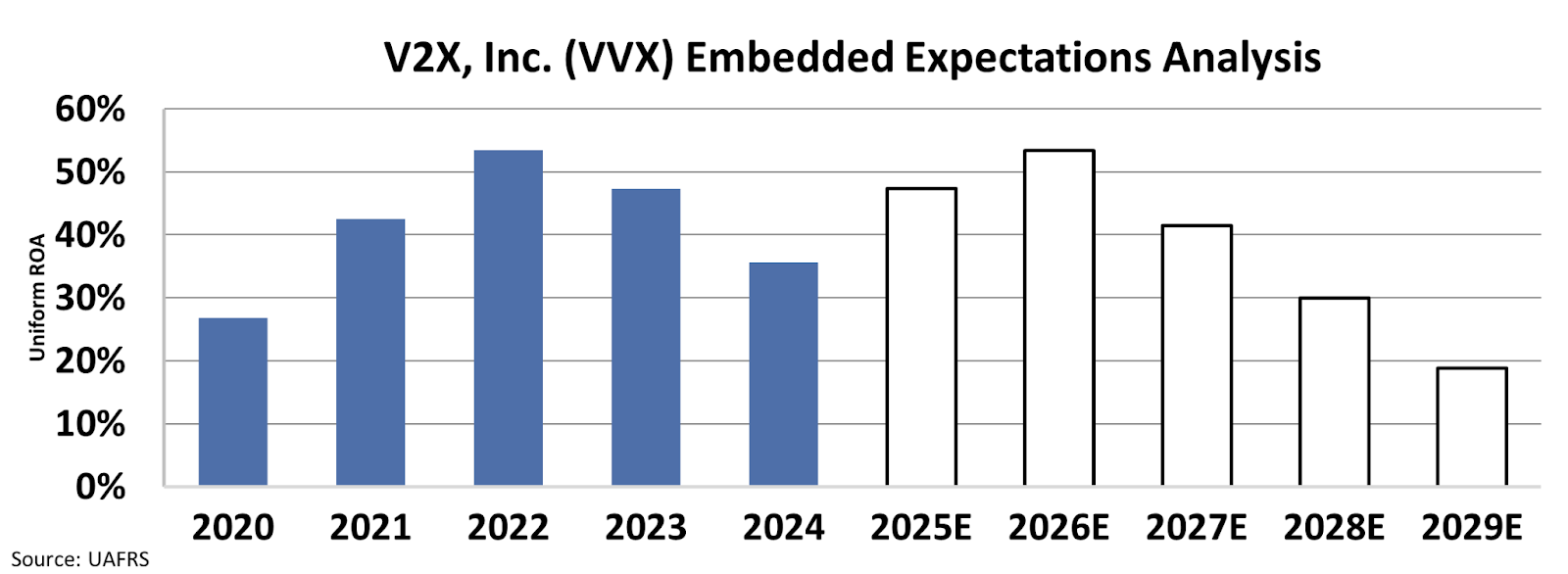
While the market’s caution stems from concerns about V2X’s contract concentration and future government spending, the company’s long-term contracts, essential services profile, and the sustained need for logistical and operations support for the U.S. military underpin stable earnings growth and sustained returns.
Best regards,
Joel Litman & Rob Spivey
Chief Investment Officer &
Director of Research
at Valens Research