
This semiconductor firm is an example of what happens when lofty investor expectations aren’t met

The AI boom has ushered in a trillion-dollar spending spree as hyperscalers race to compete against each other in the buildout of the most advanced AI models.
As a result, expectations are high for companies in the space. And over the past few months, concerns about an AI bubble have made their way into the mainstream media narrative.
With investors becoming more concerned about the potential returns of AI-related investments, companies are now under greater pressure to meet these lofty expectations, as any misstep could lead to selloffs.
Unfortunately, that’s exactly what happened to Broadcom (AVGO) as its stock slumped despite delivering strong results during its most recent quarter.
Investor Essentials Daily:
Wednesday News-based Update
Powered by Valens Research
The AI boom has massively contributed to the U.S. economy, turbocharging stock prices for AI firms, other tech companies, and the market as a whole.
Global AI spending is expected to surge to $1.5 trillion this year, as hyperscalers like Alphabet (GOOG), Meta (META), Amazon (AMZN), semiconductor firms Nvidia (NVDA) and AMD (AMD), and AI leader OpenAI have committed to spending billions on data centers and advanced AI chips.
However, over the past few months, concerns about an AI bubble have made their way into the mainstream media narrative, as some have expressed doubts about the ability of companies going all in on AI to extract returns on their multibillion-dollar investments.
Influential voices like Michael Burry have even actively bet against AI and have expressed doubts about the profitability of Nvidia and others.
With these sentiments floating around, AI companies are under even greater pressure to meet lofty investor expectations because a single misstep or two could lead to selloffs and even appear to validate concerns about the industry as whole.
And that’s exactly what happened to Broadcom (AVGO) last week even though it delivered a strong quarter.
The chip designer announced revenues of $18 billion during the fourth quarter of 2025, which beat analyst expectations by $560 million and represented a 28% year-over-year improvement. However, since the December 11 earnings call, Broadcom’s stock has sunk by 15%, wiping out over $300 billion in market cap.
The selloffs occurred after the company notified investors about near-term margin pressures. And even though CEO Hock Tan said Broadcom had a $73 billion backlog over the next six quarters, this wasn’t enough to stem concerns as investors were left underwhelmed.
Broadcom’s results were by no means lackluster, but the selloffs do indicate that investors are starting to worry whether the billions of capital expenditure in AI will yield strong returns.
This decline in Broadcom’s stock is also an indicator of the market’s lofty expectations. This can be seen through Valens’ Embedded Expectations Analysis (“EEA”) framework.
The EEA starts by looking at a company’s current stock price. From there, we can calculate what the market expects from the company’s future cash flows. We then compare that with our own cash-flow projections.
In short, it tells us how well a company has to perform in the future to be worth what the market is paying for it today.
Investors have sky-high expectations for Broadcom as can be seen below. By 2029, they expect the company to deliver a Uniform return on assets (“ROA”) of 280%, well above the 66% ROA that was delivered last year.
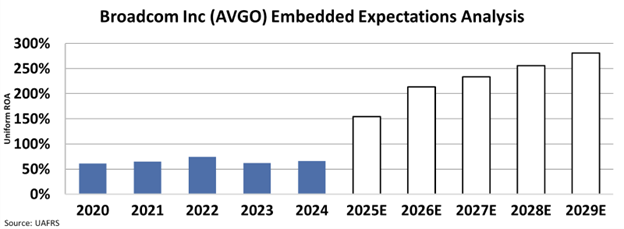
These expectations far exceed what Broadcom has delivered during the past few years of the AI boom. And while there’s no doubt it’s a crucial player in the AI industry, once it shows hints it cannot meet the market’s sky-high expectations, the market will punish it accordingly.
AI has the potential and ability to turbocharge productivity and returns—and that’s why investors have lofty expectations.
And while there’s a plethora of investment opportunities during this boom, investors will have to be careful in identifying which stocks to invest in and understand the expectations inherent in their respective valuations.
Best regards,
Joel Litman & Rob Spivey
Chief Investment Officer &
Director of Research
at Valens Research