
This social media giant is moving on from the “metaverse”

The metaverse—a digital space where individuals can interact with each other regardless of distance—was hailed by Facebook CEO Mark Zuckerberg as the “successor of the mobile Internet” in 2021.
The belief in this vision was so strong that Facebook was even rebranded to Meta Platforms (META) in the same year.
Unfortunately, the company’s metaverse-related efforts have lost over $77 billion since 2020. And with the AI race intensifying further, Meta needs every resource it can get to keep up with rivals like Microsoft (MSFT) and Alphabet (GOOG).
And last week, reports surfaced indicating Meta would be cutting as much as 30% from the budget of its metaverse division.
With Meta moving on from the metaverse and focusing on AI, investors are ecstatic, hoping this shift could help the company regain past profitability.
Investor Essentials Daily:
Wednesday News-based Update
Powered by Valens Research
2021 was a big year for social media giant Facebook as it was rebranded to Meta Platforms (META), symbolizing its strategic shift from dominating social media towards the creation of the “metaverse”—a digital space aided by virtual and augmented reality where individuals could socialize and even work.
CEO Mark Zuckerberg hailed the metaverse as the “successor of the mobile Internet,” predicting it could reach as many as a billion users within the next decade. This promise was so powerful that it was even labeled as a “trillion-dollar revenue opportunity.”
Unfortunately, all this hype didn’t materialize into reality. A year after the rebrand, it was revealed that the metaverse suffered from a combination of glitchy technology, uninterested users, and a lack of strategic clarity.
Since 2020, Meta’s Reality Labs division, which houses its metaverse-related efforts along with its AR and VR initiatives, has lost over $77 billion.
And after years of losing money, it seems Meta is finally ready to move on from the metaverse.
Last week, it was reported that Meta executives are considering potential budget cuts which could go as high as 30% for the metaverse group, with the resources pulled from this initiative being shifted to the company’s AI-powered wearables which include the popular Ray-Ban AI glasses.
The metaverse pivot has drawn negative attention from investors who consider the entire effort a drain on Meta’s resources.
Meta is currently attempting to carve a place for itself in today’s AI boom and that’s why it’s doing everything it can to keep up with AI heavyweights like Microsoft (MSFT) and Alphabet (GOOG).
Earlier this year, Zuckerberg announced the creation of a Superintelligence division to advance the company’s AI efforts while recruiting talent with compensation packages reaching $100 million.
Meta has also indicated to investors that it would increase its capital expenditure to stay competitive in the AI race.
This AI pivot isn’t just about the development of advanced models like Llama but also the creation of AI-enabled wearable tech.
The company’s Ray-Ban AI-powered glasses has gained ground in recent years, having sold over 2 million pairs.
Even though the details of the metaverse budget cut have yet to be finalized, investors have reacted positively to the news, with shares rising as much as 3% after the reports emerged.
Uniform Accounting reveals why investors are ecstatic about this strategic shift.
From 2017 until 2021, Meta consistently generated Uniform return on assets (“ROA”) between 37% and 56%. However, Uniform ROA has failed to surpass 30% levels since the company began investing heavily into the metaverse.
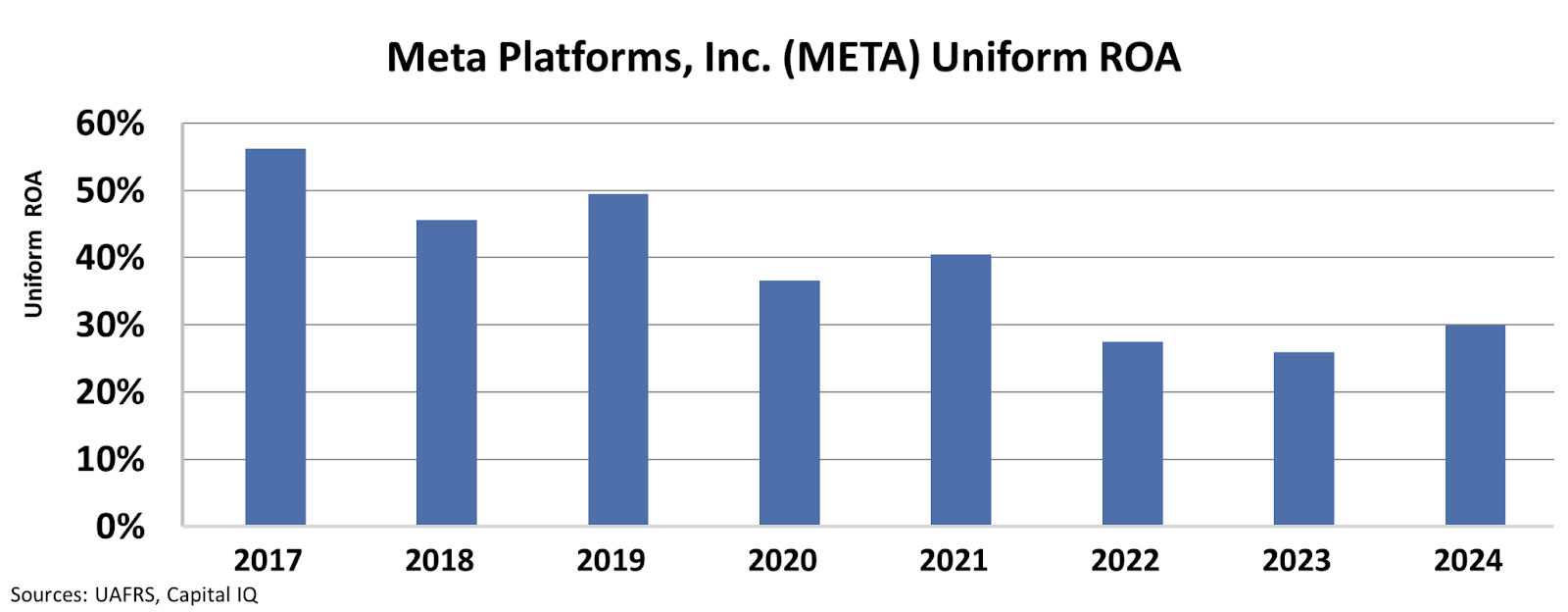
With Meta moving on from its metaverse ambitions and shifting available capital into the development of its AI offerings, investors are hoping it can recapture its former glory.
If moving on from the metaverse unlocks profitability once more, it could translate to significant upside for investors.
Best regards,
Joel Litman & Rob Spivey
Chief Investment Officer &
Director of Research
at Valens Research