
This strategic acquirer is positioned to sustain its high levels of returns

For years, TransDigm Group (TDG) has generated returns well over 40% by being a strategic acquirer of aerospace equipment manufacturing firms.
TransDigm seeks out firms that manufacture FAA-approved parts to become the company that manufactures them.
Since parts like this are complex and require regulatory approval to be released in the market, airlines rarely change suppliers.This enables TransDigm to secure years of recurring revenue.
And last week, the company announced the acquisition of Jet Parts Engineering and Victor Sierra Aviation Holdings for a total of $2.2 billion from Vance Street Capital.
Investor Essentials Daily:
Wednesday News-based Update
Powered by Valens Research
Formed in 1993, aerospace equipment manufacturing firm TransDigm Group (TDG) made a name for itself through a simple business model.
The company pays close attention to the U.S. Federal Aviation Administration’s (“FAA”) tests and regulations and looks out for companies that receive approval for a specific part.
TransDigm then seeks out that firm and acquires it. With the new business under its belt, it becomes the company that produces the newly FAA-approved part.
And throughout the years, the firm has acquired manufacturers that produce parts with no easy substitutes.
Since parts take a long time to develop and get approval, airlines rarely change suppliers, enabling TransDigm to secure consistent recurring revenues.
Through this business model, the company has strengthened its grip on the aerospace supply chain.
In other words, TransDigm operates much like a private equity (“PE”) firm, buying up businesses that have the potential to unlock value and deliver consistent revenue.
And last week, the aerospace equipment player made another acquisition that could unlock more value and upside.
TransDigm announced that it would acquire Jet Parts Engineering and Victor Sierra Aviation Holdings for a total of $2.2 billion from Vance Street Capital.
Jet Parts Engineering is a designer, manufacturer, and provider of parts and repair solutions for commercial, regional, and cargo airlines. The firm generates most of its revenue from the commercial aftermarket segment.
Meanwhile, Victor Sierra specializes in aftermarket parts for both the general and business aviation markets. Under its umbrella are McFarlane Aviation and Tempest Aero Group.
These firms delivered a combined revenue of $280 million in 2025 and have exposure to the commercial aerospace aftermarket.
Analysts say the move wasn’t just a routine acquisition, but marked a deeper pivot into Parts Manufacturer Approval (“PMA”) components. This is because for decades, TransDigm has focused primarily on proprietary components.
PMA parts are third-party components to original equipment spares and are seen as a disruptor and challenger to traditional aftermarket pricing.
TransDigm CEO Mike Lisman said both companies align with the firm’s strategy of targeting aftermarket customers.
The company’s business strategy has allowed it to generate billions in revenue over the years, with revenue soaring from $2.4 billion in 2014 to $8.8 billion in 2025.
TransDigm has also delivered strong returns over the past decade. Since 2015, its Uniform return on assets (“ROA”) has never dipped below 40%, well above corporate averages.
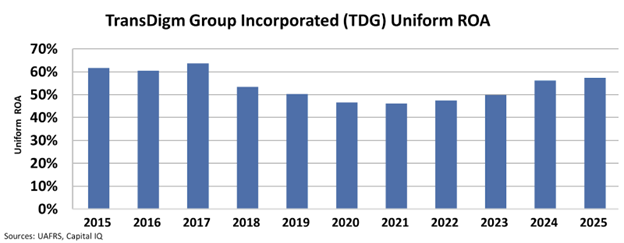
Reports indicate investor concerns about TransDigm’s slowing deal flow. However, if it continues to make similar acquisitions like the ones it made last week, the company should be well-positioned to sustain its strong levels of performance for years to come.
Best regards,
Joel Litman & Rob Spivey
Chief Investment Officer &
Director of Research
at Valens Research