
This tech giant’s stock still has room to run

Alphabet (GOOGL) was dismissed as a secondary player during the early years of the AI boom because it took the company years to develop an AI model that could rival OpenAI’s ChatGPT.
That narrative has shifted as Gemini 3, the company’s latest AI model has outperformed rivals in reasoning, coding, and other complex problem-solving tasks.
However, there’s more to Alphabet’s AI story than meets the eye, Gemini is only one part of its broad strategy.
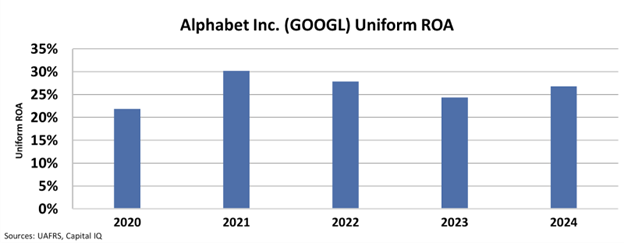
Alphabet has delivered returns above 20% in the past few years as it possesses the critical components needed to dominate the AI race.
Despite this, the company only trades at Uniform P/E of 26.8x, just slightly above the market average of 25x, suggesting that there’s still room for this stock to run.
Investor Essentials Daily:
Tuesday News-based Update
Powered by Valens Research
Google spent most of the AI boom’s early years behind AI leader OpenAI, the creator of the popular AI chatbot ChatGPT.
Expectations for Google in this race were high because as early as 2015, AI was identified as a priority for the company by CEO Sundar Pichai. And as part of that strategic vision, the company allocated resources to Google Brain, its AI research division which was bolstered by the 2014 acquisition of AI research lab DeepMind.
On top of that, Google kickstarted the development of its own AI chips called tensor-processing units (“TPUs”) in anticipation of the computational requirements needed to support its AI development efforts.
TPUs were billed as a game changer because they were designed to draw less power than both CPUs and GPUs under computational workloads.
With those resources in hand, Google developed its own AI chatbot, proceeding carefully so as to avoid and mitigate problems such as the production of inaccurate or biased information.
Fast forward to late-2022, OpenAI made ChatGPT available to the public. In just a matter of weeks, millions flocked to make use of ChatGPT. And after two months, monthly users surged to 100 million, making it the fastest-growing app in history.
Meanwhile, Google took some time before it could release its own chatbot, doing so in March 2023. Bard, as it was called, wasn’t as popular as ChatGPT because it fell behind the latter in terms of performance.
Nearly a year later, Bard was rebranded to Gemini following the release of a new large-language model based on the same name.
Until late last year, Google was dismissed by investors as a laggard in the AI race, with the narrative being that the company had fallen behind due to its inability to release an AI chatbot as fast as OpenAI did.
Moreover, the negative sentiment surrounding Google was further worsened by concerns that ChatGPT and other AI chatbots would threaten its cash cow search business, which was also under regulatory scrutiny.
Fast forward to 2026, Google has turned that negative sentiment around, as it’s now seen as a leading player in the AI race.
This comes amid the launch of Gemini 3 in October last year. According to industry benchmarks, Gemini 3 leapfrogged its competitors in reasoning, coding, and other complex problem-solving tasks.
Gemini 3’s performance even surprised rivals, forcing OpenAI CEO Sam Altman to declare a “code red” at his company after acknowledging that it could create “temporary economic headwinds” for his firm.
It may have taken time, but Google has finally turned a corner in its AI strategy, and is now positioned to further entrench its leading position in the AI arms race. The company recently announced its intent to spend $185 billion on data centers this year.
However, Gemini is only part of Alphabet’s (GOOGL) AI story.
Alphabet is the only company that controls all four pieces needed to win the AI race. First, it owns an industry-leading model with Gemini. Second, it operates one of the biggest data-center networks on the planet. Third, it has access to vast swaths of training data through its search business, YouTube, and cloud services.
Tying all these competitive advantages together is Alphabet’s hardware. Its TPUs have been around for over a decade and have matured through multiple iterations.
Simply said, Alphabet is the only firm that possesses all the critical components needed to dominate the AI race. And for the past few years, the company has leveraged all of these advantages to deliver high returns. The tech giant recently revealed that its 2025 revenues breached the $400 billion mark for the first time.
Alphabet’s returns have never dipped below 20% since 2020. In 2024, the company delivered a ROA of 27% and a Uniform asset growth of 16%.
Yet despite generating elite returns, Alphabet only trades at a Uniform P/E of 26.8x, slightly above the market average of 25x.
For a business with Alphabet’s scale, this is a remarkably low number. On the other hand, this also shows investor expectations remain far from being stretched.
As long as Alphabet continues to execute on its AI strategy and continues to hold on all of its advantages, the company’s stock still has room to run, positioning investors for some upside.
Best regards,
Joel Litman & Rob Spivey
Chief Investment Officer &
Director of Research
at Valens Research