
This Wall Street icon is actively betting on this meme stock

GameStop (GME) grabbed headlines five years ago when its stock surged by roughly 1,500% following a short squeeze instigated by retail investors.
Since then, the mania surrounding the meme stock died down and has seen 100%+ jumps followed by steep declines.
While the company has flown largely under the radar in recent years, it made headlines again when infamous short-seller Michael Burry disclosed that he had been buying shares of the firm.
Burry argued that his move is less of a meme stock bet and more of a long-term value play. However, Uniform Accounting doesn’t share his optimism on this volatile stock.
Investor Essentials Daily:
Friday News-based Update
Powered by Valens Research
Wall Street icon and infamous short-seller Michael Burry—who became famous for betting against the U.S. housing market—recently made headlines after disclosing in a Substack post that he had been buying shares of GameStop (GME), a meme stock that was at the center of a frenzy in 2021.
GameStop grabbed headlines five years ago when its stock surged by roughly 1,500% when a large number of retail investors bought its stock. Prior to this event, the company was shorted by investors who expected its stock to drop further.
The mania surrounding GameStop’s stock eventually died down. And since then, its stock has seen 100%+ jumps followed by steep declines.
Burry’s move is less of a meme stock bet and more of a long-term value play, as he emphasized in his Substack post.
He justified his move by saying GameStop CEO Ryan Cohen is “making lemonade out of lemons” and acknowledged that Cohen is “taking advantage of the meme stock phenomenon to raise cash and wait for an opportunity to make a big buy of a real growing cash cow business.”
Burry even went as far by claiming that GameStop could become a business similar to Berkshire Hathaway—an assessment that’s seemingly validated by the company’s expansion into the collectibles market and stockpiling of Bitcoin as part of its attempts to redefine its overall business strategy.
Cohen also revealed that he intends to acquire a publicly traded consumer company that’s bigger than GameStop in a deal that has the potential to be “transformational” for the company.
While Burry’s ideas regarding GameStop may seem intriguing in theory, Uniform Accounting doesn’t share his optimism for the meme stock.
Since 2017, GameStop’s Uniform return on assets (“ROA”) has declined steadily from 15% to just 1.6% by 2021. And from 2022 to 2024, the company delivered negative returns.
And while its returns inflected positively last year, ROA sits at just 0.3%.
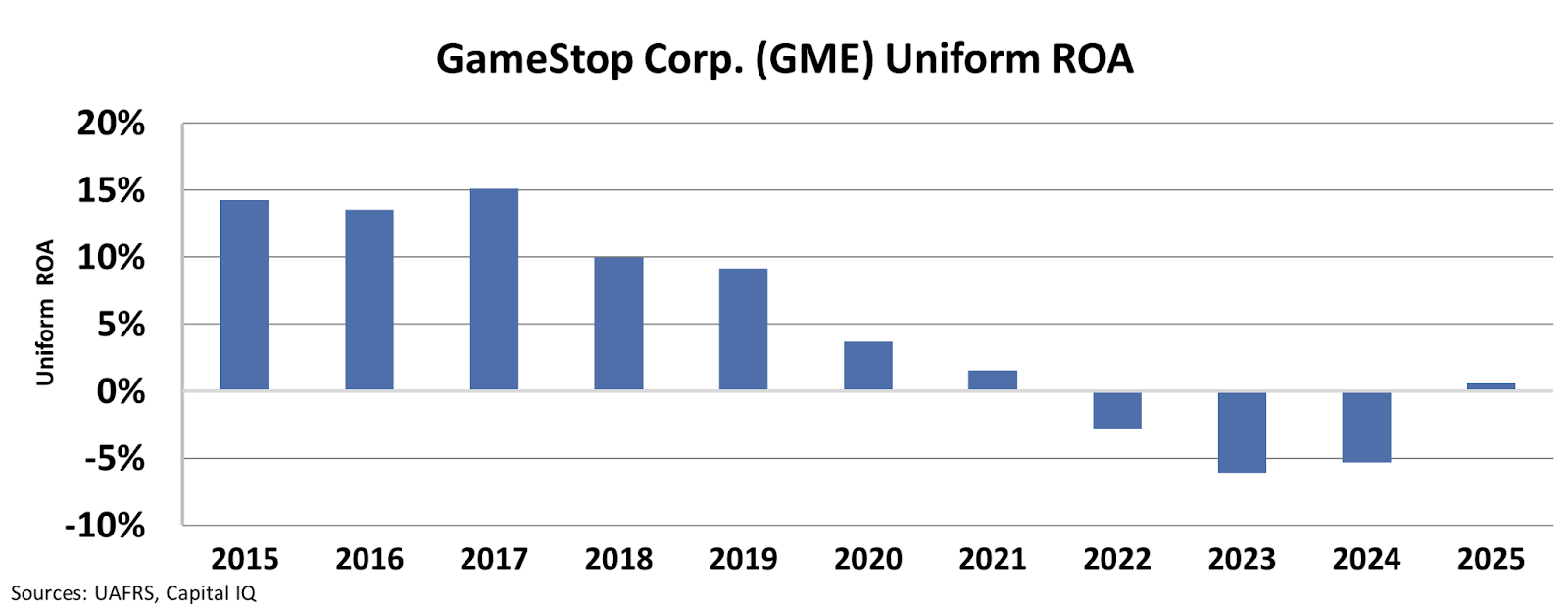
GameStop’s steady decline coincided with the decline of physical media for video games. As online marketplaces improved, people stopped buying video games from stores since these could be downloaded online.
While the company has made efforts to redefine itself, its core business is dying and it remains to be seen whether its strategic moves would pay off long-term.
At this point, GameStop is still a meme stock that’s far too volatile to put money into.
While it’s insightful to know where the brightest minds in Wall Street are putting their money, it doesn’t mean investors should follow in their footsteps.
Best regards,
Joel Litman & Rob Spivey
Chief Investment Officer &
Director of Research
at Valens Research