
Traders are changing their tune on interest rates

Investors welcomed Kevin Warsh’s ascension as Federal Reserve chairman with hard line expectations on interest rates.
However, his first public appearance bucked that view. Instead of indicating rate cuts, the new Fed chair emphasized the importance of not allowing inflation pressures to linger. As a result, markets had little reason to expect interest rate cuts.
However, a few words said in Portugal has convinced traders to change their tune on rate cuts yet again.
Investor Essentials Daily:
The Monday Macro Report
Powered by Valens Research
Kevin Warsh began his tenure as Federal Reserve chairman with investors expecting a hard line on interest rates. And that’s the reason why President Donald Trump nominated him in the first place.
The President believes interest rates should be lowered to support the economy.
But Warsh’s first public appearance gave investors doubt about that view as he emphasized the danger of allowing inflation pressures to linger, giving markets little reason to expect interest rate cuts.
As a result, traders began preparing for the possibility that the Fed’s next move would be another hike.
However, a few words said in Portugal changed this view.
Warsh, in a speech made at the European Central Bank’s annual forum in Sintra, Portugal, seemed to indicate that he was softening his stance on inflation.
While he maintained that the Fed will not tolerate inflation above 2%, he also said inflation risks have recently declined.
The change in tone was subtle. Warsh did not signal that rate cuts were imminent. Still, the market heard a chairman who appeared more comfortable with the inflation backdrop than he had sounded a few weeks earlier.
The Fed sets short-term interest rates based on where inflation and economic growth are heading. A smaller inflation threat gives policymakers more flexibility to respond when employment or spending begins to weaken.
The change in expectations was visible in the overnight swaps market.
Investors will trade instruments based on future interest rates to protect themselves from swings, and we can see how many rate cuts (or hikes) the market expects based on the prices for those trades. The market still reflects roughly 32 basis points of rate-hike premium by year-end.
That amounts to at least one full quarter-point increase—if not two before the end of the year.
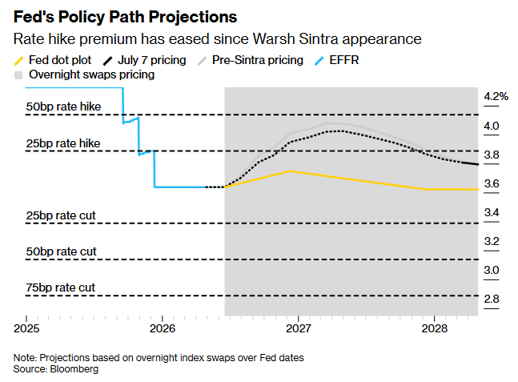
Chart from Bloomberg
That’s down slightly from prior expectations, but it suggests that, as expected, Warsh is being patient when it comes to making decisions. He’s not going to hike or cut rates until it’s time.
More importantly, options traders took Warsh’s comments to be a bigger reversal.
We can see this by looking at recent options trading for the Secured Overnight Financing Rate (“SOFR”).
SOFR tracks expectations for the Fed’s policy rate. The higher the SOFR price, the lower traders expect for future interest rates.
Recent activity has increasingly favored trades that gain value as expectations for rate hikes disappear.
One large trade even expects the Fed to cut rates before the end of the year.
It wasn’t just Warsh’s comments that had the market getting more bullish. The economy seemed to be getting stronger, too.
Rising oil prices was one of the main drivers of inflation over the past few months. And even though the fighting in Iran seems to be flaring up again, the price of oil still sits below the $100+ levels observed during the Iran war’s peak.
On top of that, the June inflation report was underwhelming. The economy added about half as many jobs as expected. While the Fed has to watch inflation, it also needs to be mindful that higher rates can cause higher unemployment.
A cooling labor market creates room for the Fed to keep rates flat or even cut them without immediately reigniting inflation.
That said, only Warsh knows what’s coming next.
Recent investor reactions indicate that the market’s initial reaction to his inflation comments were too bearish.
From here on out, key indicators, such as oil prices, will have to be watched closely. If prices rise astronomically again, that could reignite inflation fears in the next few months.
In all, investors should treat the remaining hike premium as a measure of uncertainty rather than a firm policy forecast. Warsh’s tone has softened, and sophisticated traders are positioning for a friendlier outcome.
Warsh will not hike rates prematurely. And the market still has some room to rally after investors get comfortable with current interest rates.
Best regards,
Joel Litman & Rob Spivey
Chief Investment Officer &
Director of Research
at Valens Research