
Uncertainty is preventing investors from rewarding this entertainment behemoth

Disney(DIS) has faced years of hardship and underperformance due to pandemic-driven shutdowns and the tremendous costs associated with standing up its streaming platform, Disney+.
With the company losing billions of dollars due to closures to its experience segment and investments into Disney+, its operating income fell from $12 billion in 2019 to $3.5 billion in 2021.
As the company’s stock took a hit, internal disputes ensued and investors confidence tanked. As a result, the firm’s board decided to bring longtime CEO Bob Iger back into the fold in 2022, two years after he turned over the reins to Bob Chapek.
Since then, Iger has managed to right the ship at Disney, as the company has seen its returns climb back from historic lows.
Yet despite this turnaround, investors have yet to reward the company, as questions continue to swirl around its future leadership.
Investor Essentials Daily:
Wednesday News-based Update
Powered by Valens Research
Disney (DIS) had a rough few years as it navigated the COVID-19 pandemic and the launch of its streaming business.
The company lost billions of dollars in revenue due to pandemic-induced closures to its theme park and cruise line businesses—segments which accounted for 38% of sales in 2019. Revenues for the experiences segment plunged 36% in 2020.
This market headwind came amid the launch of the firm’s streaming platform, Disney+. Even though Disney+ grew its subscriber base to 160 million by 2022, Disney was losing $4 billion annually just to compete with Netflix, HBO, and Amazon.
The combination of park shutdowns and expenditures tied to its streaming platform weighed heavily on Disney’s bottom line, driving down its operating income from $12 billion in 2019 to $3.5 billion in 2021.
With all these headwinds weighing down on Disney, investor confidence dipped, leading to a 40% hit to its stock.
With confidence down and internal disputes ensuing, longtime CEO Bob Iger returned in late 2022, just two years after handing the reins to Bob Chapek.
Iger’s first tenure as Disney CEO from 2005 to 2020 was largely successful, as the company delivered an average Uniform return on assets (“ROA”) of 14% from 2005 to 2019.
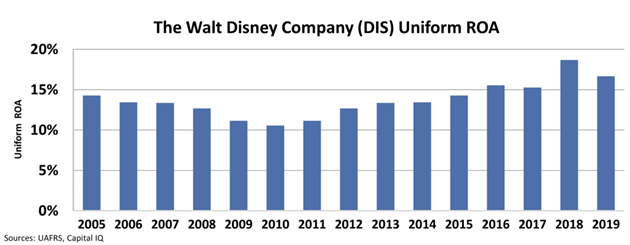
After ROA fell to just 5% during the pandemic, Iger has successfully turned Disney’s profitability around, rebounding to 13% in 2025.

And recent results further confirm this positive momentum. During the first quarter of 2026, the company delivered revenue of $26 billion, up 5% year over year, beating analyst estimates by $400 million.
The company’s entertainment revenues reached $11.6 billion, growing 7% year over year. Meanwhile, experiences delivered quarterly revenue of $10 billion, representing 6% year-over-year growth.
Despite Disney’s continued recovery and strong momentum across its business units, uncertainty surrounds the company due to questions about its future leadership.
Just yesterday, the company announced that Josh D’Amaro, a 28-year Disney veteran and current head of the Experiences division, will be the company’s next chief executive.
The market still doesn’t know what to expect from this new leader. Disney’s stock ended the day roughly flat on the news.
Still, the overall uncertainty surrounding Disney’s next leader has prevented investors from rewarding the company for its recovery. When seen through the lens of Uniform Accounting, the firm is still valued cheaply by investors.
We can see this through Valens’ Embedded Expectations Analysis (“EEA”) framework.
The EEA starts by looking at a company’s current stock price. From there, we can calculate what the market expects from the company’s future cash flows. We then compare that with our own cash-flow projections.
In short, it tells us how well a company has to perform in the future to be worth what the market is paying for it today.
Despite improvements in recent years, investors expect Disney’s Uniform ROA to decline in the coming years to around 10% by 2030.

After the turbulent tenure of former CEO Bob Chapek, investors are wary of the future of Disney. While D’Amaro brings plenty of experience to the job, there’s no clear indication that he will be able to replicate Iger’s magic.
Until D’Amaro officially takes over and proves he can take Disney in the right direction, investors would be best off watching this stock from the sidelines.
Best regards,
Joel Litman & Rob Spivey
Chief Investment Officer &
Director of Research
at Valens Research