
With AI turbocharging the ad industry, demand for ad verification will intensify

The AI boom is rapidly reshaping the multibillion-dollar advertising industry. With generative AI, companies can create and distribute ad campaigns in shorter timeframes.
Moreover, firms can even use AI to improve recommendation systems to increase time spent, a strategy that has been employed by social media giant (META) and Alphabet (GOOGL) on Instagram and YouTube, respectively.
These benefits ushered in by AI have stoked fears about the revenue-generating capacity of ad agencies, as generative AI tools could theoretically eliminate the need for them.
However, instead of treating AI as a threat, ad companies are embracing it to improve ad content generation.
With AI set to turbocharge the advertising industry, ad verification will become a necessity, positioning firms like DoubleVerify (DV) to benefit from this tailwind.
Investor Essentials Daily:
Wednesday News-based Update
Powered by Valens Research
The AI boom is revolutionizing many industries from finance and tech to even retail. And now, it’s rapidly reshaping the multibillion-dollar advertising industry.
AI is being leveraged by tech giants Meta (META), Alphabet (GOOGL), and Amazon (AMZN) to create and distribute ad campaigns and even improve recommendation systems to increase the time users spend on platforms like YouTube and Instagram.
With better targeting, advertisers can distribute ads to audiences more effectively.
However, despite those benefits, generative AI has stoked fears about the roles ad agencies will play in an AI-driven playing field as businesses can simply use the same tools to create and deploy the ads they need, potentially cutting out the necessity of ad companies in the process.
Despite these concerns, advertising industry giants are treating generative AI as a value add, not a threat.
WPP, for example, is investing roughly $390 million in AI this year, with $80 million earmarked for its partnership with Google and the rest going toward investments in cloud infrastructure and software development.
Ad spending is forecasted to reach $466 billion this year. With AI turbocharging how ads are created and delivered, ad verification—a process that prevents fraud and ensures ads reach human audiences—becomes crucial.
According to Cloudflare, at least 40% of web traffic consists of fake users or bots. This is a problem that has been exacerbated by malicious actors using AI.
With ad spend intensifying and the need for fraud detection intensifying rising, ad verification firms like DoubleVerify (DV) are positioned to benefit from this tailwind.
Founded in 2008, the company offers digital media measurement and analytics to its customers. Its solutions are divided into two platforms: DV Media Advantage Platform and DV Publisher Suite.
The Media Advantage Platform provides services such as fraud detection, ad placement alignment and visibility, optimization, and others. Meanwhile, Publisher Suite provides publishers with revenue analytics, inventory quality, quality targeting, and other related services.
DoubleVerify currently has a vast client portfolio that spans across multiple industries from media to retail and consumer goods. It includes notable names such as media giants such WPPMedia and Publicis Groupe, retail firm Macy’s, and even consumer goods juggernaut Procter & Gamble.
The company recently announced new offerings tailored to advertisers who are increasingly using AI. This includes AI content detectors in open web environments and AI agent management tools.
Since going public in 2021, the company has steadily grown its revenues from $332.7 million to $656.8 million last year. The firm’s Uniform return on assets (“ROA”) has also hovered at 20%+ levels in the same period.
And last year, DoubleVerify managed to achieve a Uniform ROA of 23% while simultaneously delivering a Uniform asset growth of 20%. Yet despite these results, the company trades at just a Uniform P/E of 9.8x.
Moreover, investors are expecting the company’s returns to steadily decline in the next few years.
We can see what the market thinks of DoubleVerify through our Embedded Expectations Analysis (“EEA”) framework.
The EEA starts by looking at a company’s current stock price. From there, we can calculate what the market expects from the company’s future cash flows. We then compare that with our own cash-flow projections.
In short, it tells us how well a company has to perform in the future to be worth what the market is paying for it today.
At current prices, the market expects DoubleVerify’s Uniform ROA to fall to 6.4% by 2029.
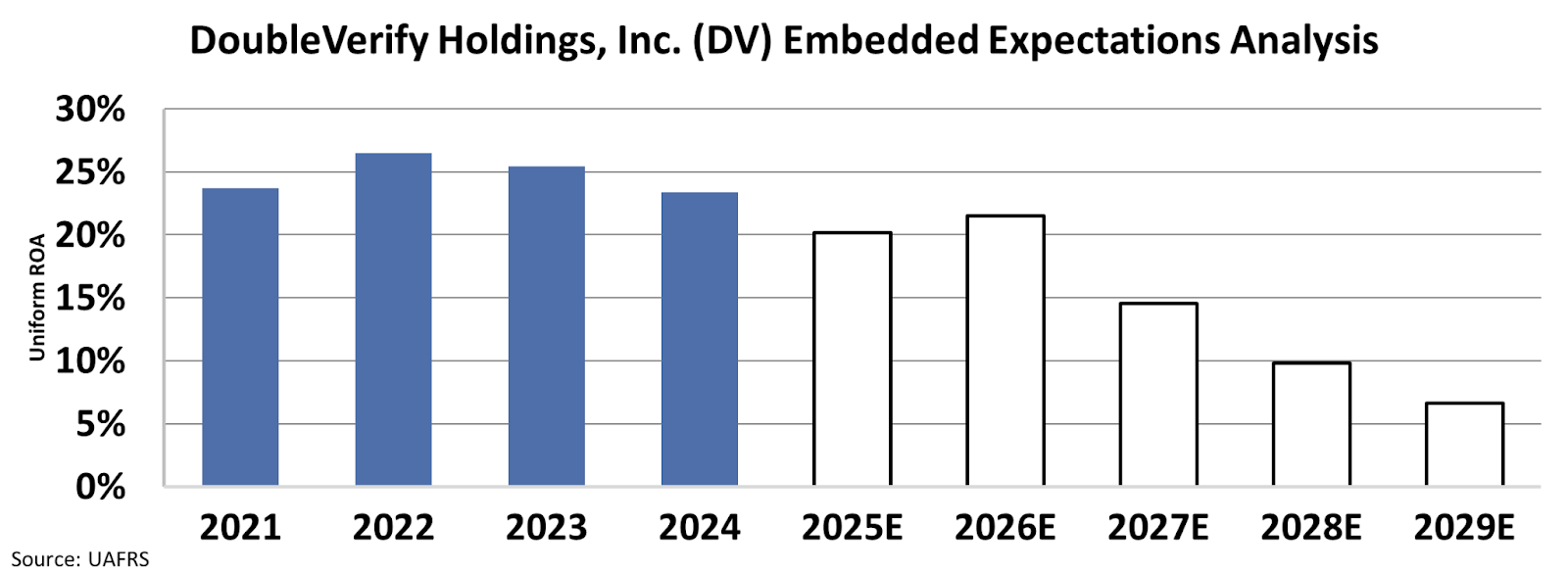
These expectations indicate that investors may be adopting a cautionary stance due to ad spending volatility and competitive pressure.
Despite this, with ad spend set to ramp up and demand for transparency and analytics in digital marketing set to grow, DoubleVerify could be in a position to continue its top-line growth and margin expansion provided it can capitalize on industry tailwinds.
Best regards,
Joel Litman & Rob Spivey
Chief Investment Officer &
Director of Research
at Valens Research